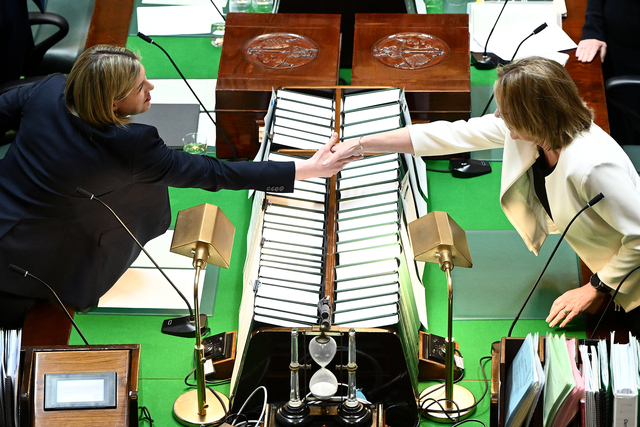
The selection of a female to lead the Victorian Liberal Party into 2026, an election, and hopefully beyond, has been welcomed as a positive step by the leading advocacy body Women for Election (WFE).
WFE chief executive officer Licia Heath said Jess Wilson’s appointment as party leader was both positive “for the party and also for political representation more broadly”.
“Plus, the fact that she’s under 40 is also a great demonstration of the capability of, and need for, younger politicians in Australia,” she said.
Ms Heath did note, however, that while having two female leaders was something new for Victoria, other states and territories reached the milestone much faster.
Five years ago, Queensland’s Labor and Liberal parties were led by Anastasia Palaszczuk and Deb Frecklington, respectively, during the state election.
In 2021, New South Wales followed suit, with Gladys Berejiklian and Jodi McKay as party leaders.
Last year, both major parties in the Northern Territory were also led by women, being Lia Finocchiaro for the Country Liberal Party and Eva Lawler for the Territory Labor Party.
“The more women we see in politics, and within leadership positions within politics, the more it’s normalised. I can’t wait for the day when our federal leaders are all women,” Ms Heath said.
As more women join and are more present in the Australian political landscape, Ms Heath said “acceptance of female party leaders has improved and become normalised”.
But she did say that more women from diverse backgrounds and communities were needed in all levels of government to have a truly representative system.
“That greater representation of women is still needed, particularly for women from politically under-represented communities such as First Nations communities and women from diverse multicultural backgrounds,” she said.
And despite the progress Australia has made both nationally and internationally as a leading example of empowering women to join the political sphere, Ms Heath said the country still falls short in some aspects.
“There’s no question that women are still judged more harshly than their male counterparts in politics (and in all other roles as well),” she said.
“But the higher visibility of politics, and the presence of media commentary, means that women still receive ridiculous commentary relating to their appearance or their family life.”
Ms Heath does believe “the public are getting better at calling this out” when they see or hear it but one of the major reasons women don’t run for election is because of online harassment and safety.
As both an advocacy platform and a training ground for women to pursue politics at all levels, Ms Heath said a far too common issue raised by the Women for Election community is online abuse.
“Whilst the office of the E-safety commissioner is doing extensive work on curtailing online harassment, we want to see harsher penalties and greater consequences for perpetrators of online trolling, so that women feel empowered to run for public office and serve their communities,” she said.
A little under a year away from a state election, Ms Heath encouraged women to join a WFE event across Victoria in early 2026.
The events are designed to “inspire and equip” women to run in the state election, and look ahead to federal and local government elections.
“I’d encourage readers to visit our webpage and register for the events or share with a woman you would like to see run in the future.
“Our events are open to all women, whether they want to be a future candidate, or perhaps just want to understand more about Australia’ political process.”
To find out more, visit: wfe.org.au/events/