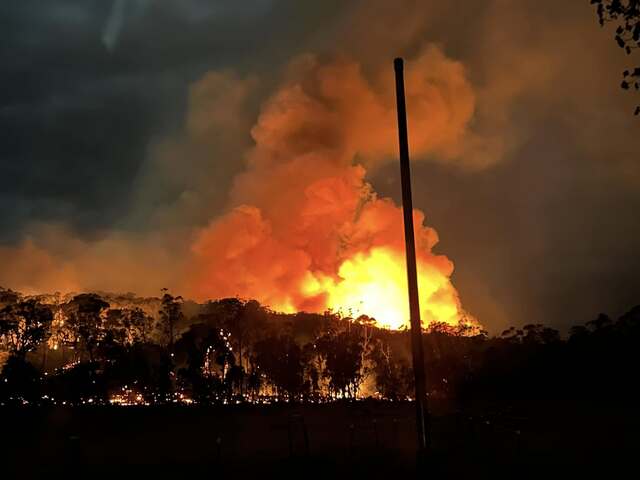
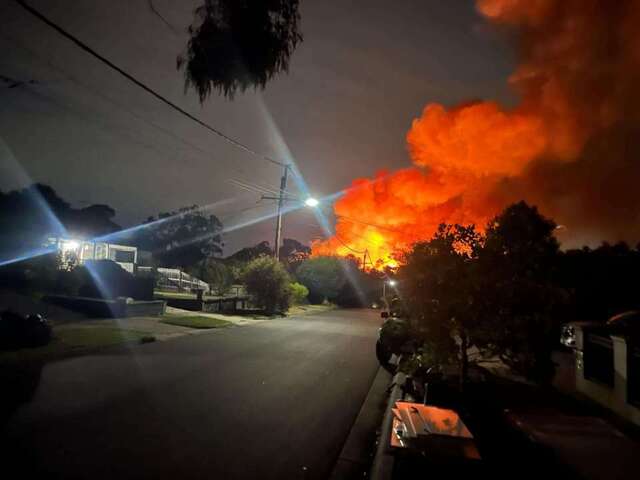
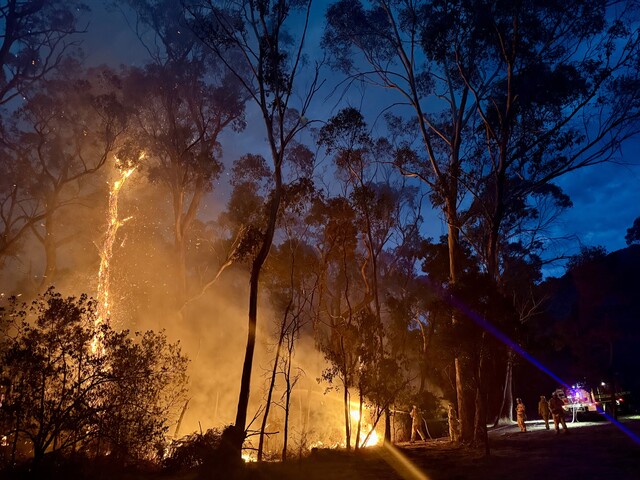
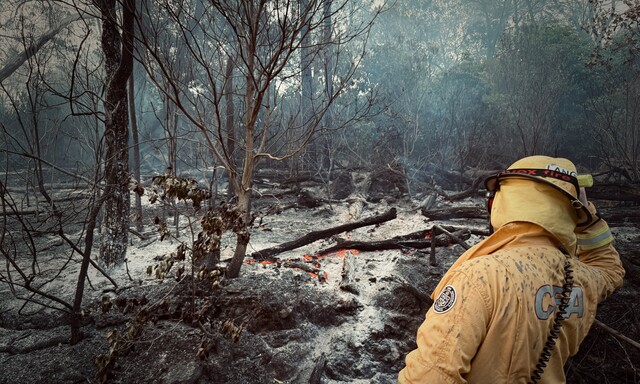
It was an unusually warm day in March that marred the start of autumn for Montrose.
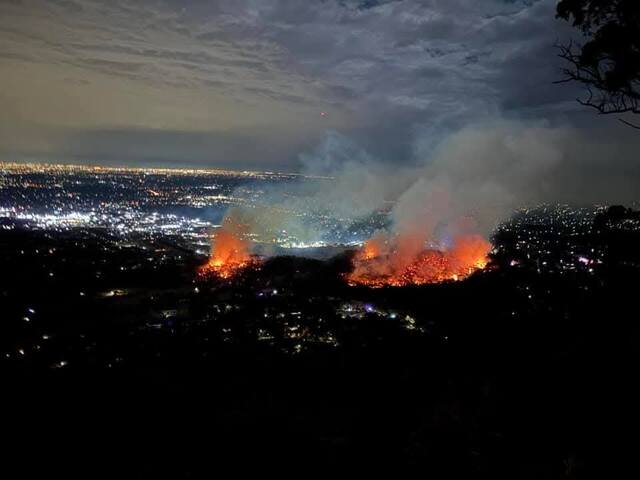
Saturday 15 March just before 2pm, firefighters were called to a bushfire. The initial response saw over 20 ground crews supported from the air.
A CFA spokesperson said fire crews responded to reports of a smoke column at around 1.43pm near Sheffield Road in Montrose.
“26 CFA units from multiple local brigades responded alongside FRV, Victoria Police and Ambulance Victoria,” they said.
“Upon arrival, crews found an active grass and scrub fire in the Dr Ken Leversha Reserve and immediately began suppression efforts.”
With firefighters attacking from all directions, CFA Incident Controller Bernard Barbetti told the ABC, “We thought we had the fire under control but it moved the fire north.”
An unexpected burst of wind caused the fire to double in size, with the final impact burning 40 hectares, damaging two houses and rendering one lost.
At 12.51am on Sunday, the situation became dire, with an emergency take shelter now warning issued, making it too late to leave.
“There is increased fire activity on the western side, near Jeanette Maree Court, and on the eastern side, near Ruby Road. There is also (a) significant ember attack on the northern edge,” the warning read.
“This fire is threatening homes and lives. It is too late to leave the area safely so you must take shelter now. You are in danger and need to act immediately to survive.”
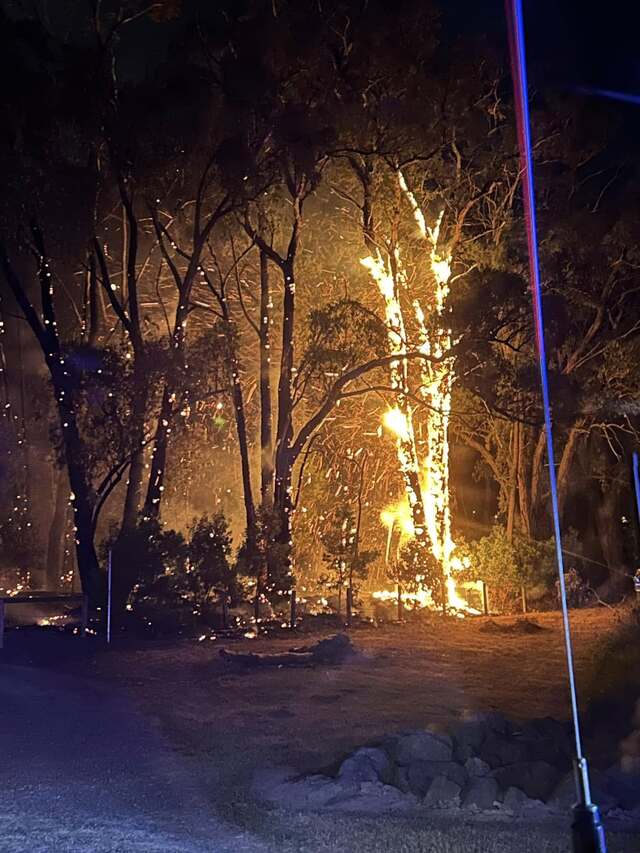
One Crestview Close resident described the moment they realised they needed to get their family out of the house: “It was raining embers.”
“I’m seeing embers flying through the air, they’re red. It’s not ash, it’s fire.
“I looked up the street and all I could see was a glow.”
These embers, sometimes the size of a screwdriver and five to 10 centimetres wide, were a sign for them to get out as soon as they could.
Items already packed in the car ready to go, with just the cat and the dog needing to be bundled into the car too, they left by about 11.30pm.
“I don’t even remember smelling the smoke until I was safe at (my in-law’s) house, but I’ve seen photos and videos and I’m just like, ‘how did I not even remember the smoke’, I was so focused on getting out.”
Having had questions since the events of Saturday night as to why they didn’t leave that afternoon, the resident said messaging led them to believe it was safe enough to stay, or in the case of Sheffield Road residents, to return home after evacuating earlier.
“You can’t just pack up every time there’s fire, small shrub and grass fires happen all the time. We were told it was contained. We couldn’t see any smoke. There was no wind.
“So yes, we went to bed at 10 o’clock with the knowledge of going outside assessing it, feeling safe enough to be there, and we were quite ok with going to bed.
“It was so sudden, within that hour…It just goes to show how quick and instant it actually can be.”
Despite some criticism of the notifications being sent out to residents and the quick change in warnings on VicEmergency, the Crestview Close resident said hopefully the bushfire acts as a learning experience for everyone.
“From everything that’s happened, I really just hope it makes people think about it more literally and look at where we live. You can’t be complacent. You can’t ignore the fact that it might happen one day.
“It should always be, especially in the summer months, on your mind, keep the house tidy, keep your lawn short, keep your gutters clean. Make sure you don’t have rubbish laying around.
“Hopefully it’s just a reality check for people of where we live, and making sure you’ve got your plan of attack in place and making sure your kids understand.
“We can’t always rely on our phones. We don’t always have reception. Even with updates, you can’t always rely on your phones for that instant alert. And if you’re asleep, you might not hear your phone go off.”
A concern from Montrose residents, voiced at a community meeting, was that the warning messages sent out via the VicEmergency app did not match the unfolding situation, with some residents identifying that they went door knocking to warn neighbours, especially the elderly, that they had mere minutes to get out.
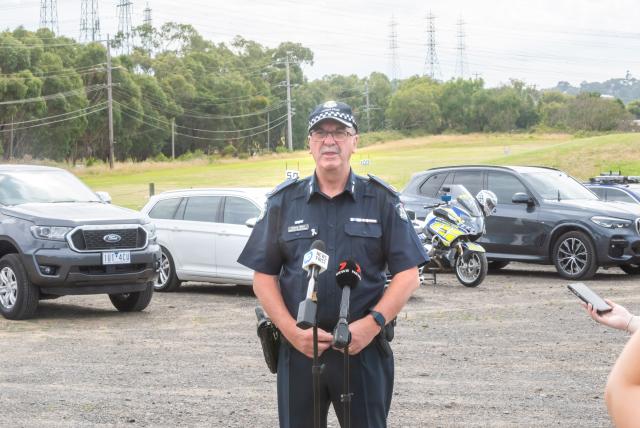
Deputy Incident Controller Mike Willmott said the difference between this fire claiming property and the Grampians bushfire early in the year claiming none, was the suburban interface and the proximity to houses.
“With just a slight breeze this fire became much more significant in the middle of the night and many CFA brigades and volunteers worked a very long 12+ hour shift to help protect lives and property,” Warrandyte CFA posted to social media.
“While this fire was not in our patch – it’s a very good example how fires can behave with the current dry conditions.”
Sunday’s rain proved helpful, stopping the spread of the fire enough to provide some relief to firefighters.
“There was some concern that it may spot over and get over into the Dandenong Ranges,” Mr Barbetti said.
“It’s a long, unburnt area. There are a lot of dead trees.”
Mr Willmott said the all agency response, including CFA, Forest Fire Management Victoria and Fire Rescue Victoria firefighters, as well as four helicopters and heavy machinery, helped contain the fire.
“They were all assisting and working as one to stop this fire from claiming more people’s residences,” he said.
“On this fire we (had) three CFA strike teams, with about 100 firefighters.”
With the fire deemed under control by late afternoon on Sunday 16 March, attention was turned to recovery.
Yarra Ranges Council began door-knocking efforts, with support from trained volunteers from the Victoria Council of Churches’ Emergencies Ministry, from Tuesday 18 March to check in on residents.
The then Mayor Jim Child said the community effort of support, kindness and out-reach has already been remarkable.
“In these difficult situations, it’s the incredible strength of our communities that shines through as they step up to support one another,” he said.
But grave concerns were held by wildlife rescuers and environmentalists who were awaiting the all clear to assess the damage and assist animals in need of treatment.
Mount Evelyn Environment Protection and Progress Association (MEEPPA) president Clare Worsnop said a major concern was loss of hollow-bearing trees.
With a known mated pair of Powerful Owls, a threatened species, calling the Dr Ken Leversha Reserve home and who welcomed twins this breeding season, Ms Worsnop said the hope is the young had already flown the hollow.
Bungalook Creek Wildlife Shelter rescuer Emma Cash said in the 24 hours until Thursday 20 March evening, “the Powerful Owls have been heard hooting”.
The area, “a high value biodiversity reserve”, is home to macropod species like Swamp Wallabies and Eastern Grey Kangaroos, possums and gliders, reptiles, birds and invertebrates, not to mention the diverse flora.
Ms Worsnop said aside from the burns themselves, a lack of food and dehydration would be a secondary cause of death to the animals stuck in the reserve.
“Resident reports give us hope that the local kangaroo mob and several wallabies have managed to escape the fire,” Ms Cash said.
“We have had a report of one deceased swamp wallaby, but the reality is there will be hundreds of animals that were not able to escape the inferno.”
With trees continuing to fall because of the unstable ground, Ms Worsnop said that “might ultimately become habitat for something else” but it will take years for the site to replenish.
“It may take several years before the regrowth comes back, and there’s enough food and shelter for those critters that have lost their homes,” she said.
“The loss of habitat, for what was living in it, especially if the big, old trees with hollows, those ones won’t exist anymore, and that will also have an impact on the future of the wildlife there, and it will take many years for it to totally regenerate.”
Six months later, small signs of rejuvenation were beginning to appear, but it was described by Ms Worsnop as a “slow process”.
“Caring for the bush and helping it to regenerate naturally as well as working out what is necessary in the longer term with re-vegetation is a long process.”
According to Ms Cash, locals can help out the local wildlife in a series of ways.
“People that live around the area can make their gardens as wildlife friendly as possible,” Ms Cash said.
“This involves planting native trees and shrubs and ground covers so that our wildlife have something safe to eat, but also installing nesting boxes in appropriate locations and keeping cats indoors.”